
/
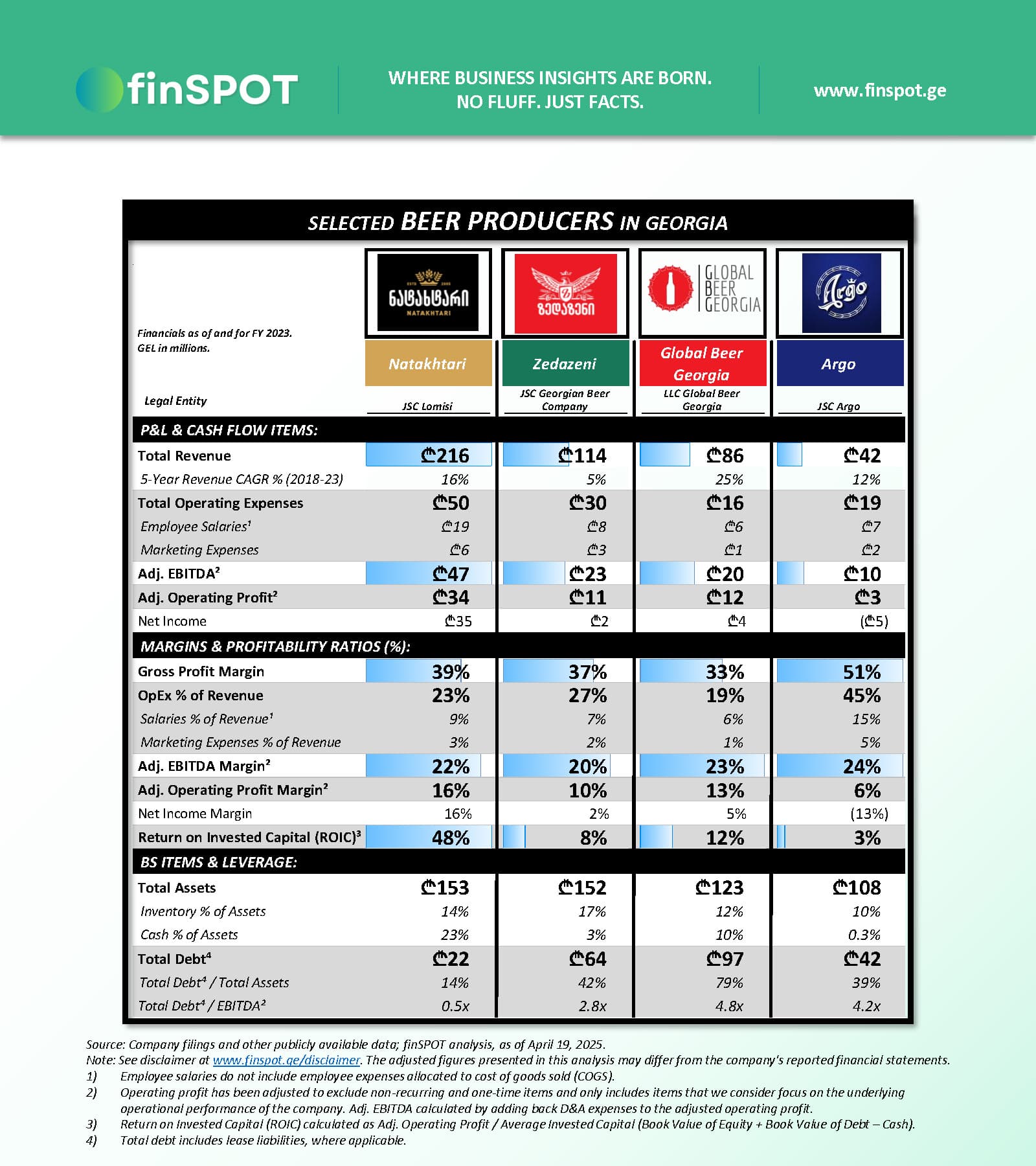
 A look at the brewing business through the 4 largest producers:
1️⃣ JSC Lomisi (Natakhtari)🍺: Natakhtari, Karva, Kasris, Taati, Extra, Efes, Löwenbräu, Staropramen, Corona… 🥤: Natakhtari lemonade…
2️⃣ JSC Georgian Beer Company (Zedazeni) 🍺: Zedazeni; Ravi; Aia; Bavaria; Holsten; Ragnar; Harp; Miller… 🥤: Zedazeni lemonade; Chero; RC Cola Georgia; Gurieli ice tea; Dilmah ice tea…
3️⃣ Global Beer Georgia LLC (Global Beer Georgia) 🍺: Icy; Kayak; Kazbegi; Black Lion; Heineken; Krušovice; Amstel… 🥤: Kazbegi lemonade…
4️⃣ JSC Argo (Argo) 🍺: Argo; Aluda; Herzog; Hollandia… 🥤: Zandukeli lemonade; Argo hard seltzer…
The brewers covered produce both local beer and licensed brands (Heineken, Miller and so on). They also import various foreign beers.
The top 4 companies' capacity exceeds real demand in the local market. That is why the companies pay so much attention to developing exports and to producing non-alcoholic, energy and soft drinks.
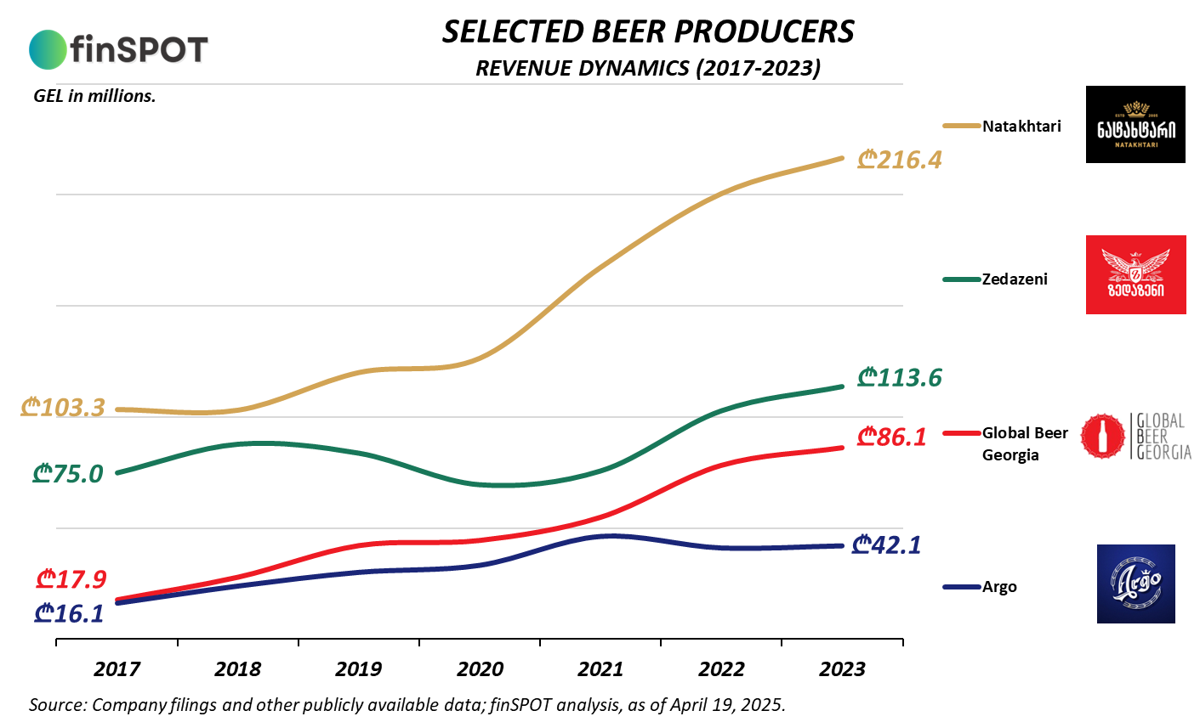
The companies' combined revenue almost doubled in 5 years, to ₾458 million in 2023. Almost half of that comes from the market leader (Natakhtari).
Brewing is a capital-intensive business. Over the past 5 years the companies' CapEx averaged about 13% of revenue. Capital expenditure is especially high in a brewer's early years, as it establishes itself in the local market.
With high capital expenditure and the need to fund working capital, most of the companies carry sizeable borrowings.
The companies' profitability was high in 2023. The top 4's weighted average gross profit margin is 38% and EBITDA margin 22%. However, looking back over time, none of the companies apart from Natakhtari had enough cash flow to service its debt. Global Beer Georgia and Argo could not even cover capital expenditure from operating free cash flow. That is why borrowings have risen at Zedazeni, Global Beer Georgia and Argo. Natakhtari was the only one with enough cash flow both to service its debt and to reduce it — in 2018-23 it brought its loan balance down from ₾110 million to ₾22 million and built up a further ₾35 million of cash.
Foreign investment has a large share in Georgia's beer business. The largest brewer is owned by Turkey's leading brewer, Anadolu Efes, while 80% of Global Beer Georgia and 40% of Argo belong to the Netherlands' second-largest brewer, Royal Swinkels.
For the financial analysis, we look at 2023 data.
Among the companies covered, Natakhtari is the highest-revenue brewer. In 2023 its revenue was ₾216 million. Over the past 5 years Natakhtari's revenue grew 16% a year on average (CAGR). The undisputed market leader, Natakhtari is financially the strongest and most stable. The company also has: (1) a high growth rate (behind only one direct competitor); (2) strong liquidity; (3) the best-managed working capital; (4) the lowest financial leverage; and (5) an excellent return on capital.
Revenue at the number two player, Zedazeni, is almost half the market leader's, at ₾114 million in 2023. Among the largest competitors, Zedazeni has the slowest growth. In 2018-23 the company grew 5% a year on average (CAGR).
The third-largest brewer in the market is Global Beer Georgia, with revenue of ₾86 million; it is the fastest-growing company of the four (25% CAGR in 2018-23). Capital put into the company (equity + loans, net of debt repayment) exceeded ₾170 million in 2016-23. Against a capital injection on that scale, the growth achieved no longer looks quite so impressive. It also shows how much investment is needed to establish a leading position in the market.
The fourth player is Argo, whose revenue is 2 times smaller than the third-placed brewer's. Argo's revenue was ₾42 million in 2023, having grown 12% a year on average (CAGR) over the past 5 years. The company does not have enough operating cash flow either to fund capital expenditure or to service its debt. As a result, in 2017-21 Argo needed large capital injections, both as equity (₾39 million) and as loans.
The brewers' gross margins are in the range of 33%-39%. The exception is Argo, which has the highest margin of the four (51%). With sharply higher prices for brewing raw materials in recent years, gross margins have been trending down. Global Beer Georgia, however, by widening its range of own-brewed beer, managed to raise its gross margin significantly in 2019-23 — from 23% to 33%. This plays a large part in Global Beer Georgia's fast revenue growth.
Operating expenses are 25% of revenue on a weighted average. The largest single component is salaries, at a weighted average of 8.4% of revenue. On marketing the companies spend ₾1-₾6 million a year, a weighted average of 2.5% of revenue.
The weighted average operating and EBITDA margins are 13% and 22% respectively.
Given the nature of the sector, most of the companies have high leverage.
Two of the companies (Global Beer Georgia and Argo) did not have enough cash flow for capital expenditure and so none for debt service either. Zedazeni comfortably funded capital expenditure from operating cash flow but did not have enough for debt service. To fill the gap the companies increased their borrowings.
Accordingly, the companies were not able to pay dividends.
The only company that comfortably covers both capital expenditure and debt obligations is Natakhtari. As noted above, in 2017-23 the company reduced its borrowings by almost ₾90 million and increased cash on the balance sheet to ₾35 million. Natakhtari will probably start distributing dividends to its parent in the coming years.
🟢 Starting large-scale beer production in Georgia is almost impossible without an investment of tens of millions. Securing a plant, infrastructure and distribution takes a great deal of capital.

Yet the story of Zahra Tabatabai, the Iranian-born founder of the US-based brand Back Home Beer, shows that it is possible to gain a foothold with few resources. In 2021 she started the business with just $7,000. Using traditional eastern flavours — sumac and sour cherry — Tabatabai created a distinctive beer and scaled up despite having no plant of her own (she brewed under contract with another brewer). A successful Kickstarter campaign raised more than $125,000, which allows her to sell the product at more than 250 locations in New York and Washington.

The example confirms that new small producers can succeed in the Georgian market too. Tens of millions are not required; often a distinctive idea, a strong narrative/story and a strategic partnership are enough.
🟢 The chart below shows the revenue of the top 4 brewers in 2017-23:
Company ownership:
1️⃣ JSC Lomisi (Natakhtari)
💼 Ultimate controlling party:
- Anadolu Efes Biracılık ve Malt Sanayii A.Ş. (Turkey)

2️⃣ JSC Georgian Beer Company (Zedazeni)
💼 Ultimate controlling party:
- Tsezar Chocheli and Izolda Charigogdishvili (through Mixori LLC)
*In 2024 Zedazeni, together with its subsidiary (Magniti), combined with Daily Group. The latter owns the retail chains SPAR, Ioli, Daily, Kalata and Gvirila.

3️⃣ Global Beer Georgia LLC (Global Beer Georgia)
💼 Ultimate parent:
- JSC Georgia Capital: 100%
*In 2024 Georgia Capital sold 80% of the company to one of the leading international brewers, Royal Swinkels (Netherlands).

4️⃣ JSC Argo (Argo)
💼 Owners:
- Vasili Sulkhanishvili: 51%
- Royal Swinkels (Netherlands): 40%
- JSC Coca-Cola Bottlers Georgia: 9%
*The controlling stake in Coca-Cola Bottlers Georgia is held by Temur Chkonia.