
/
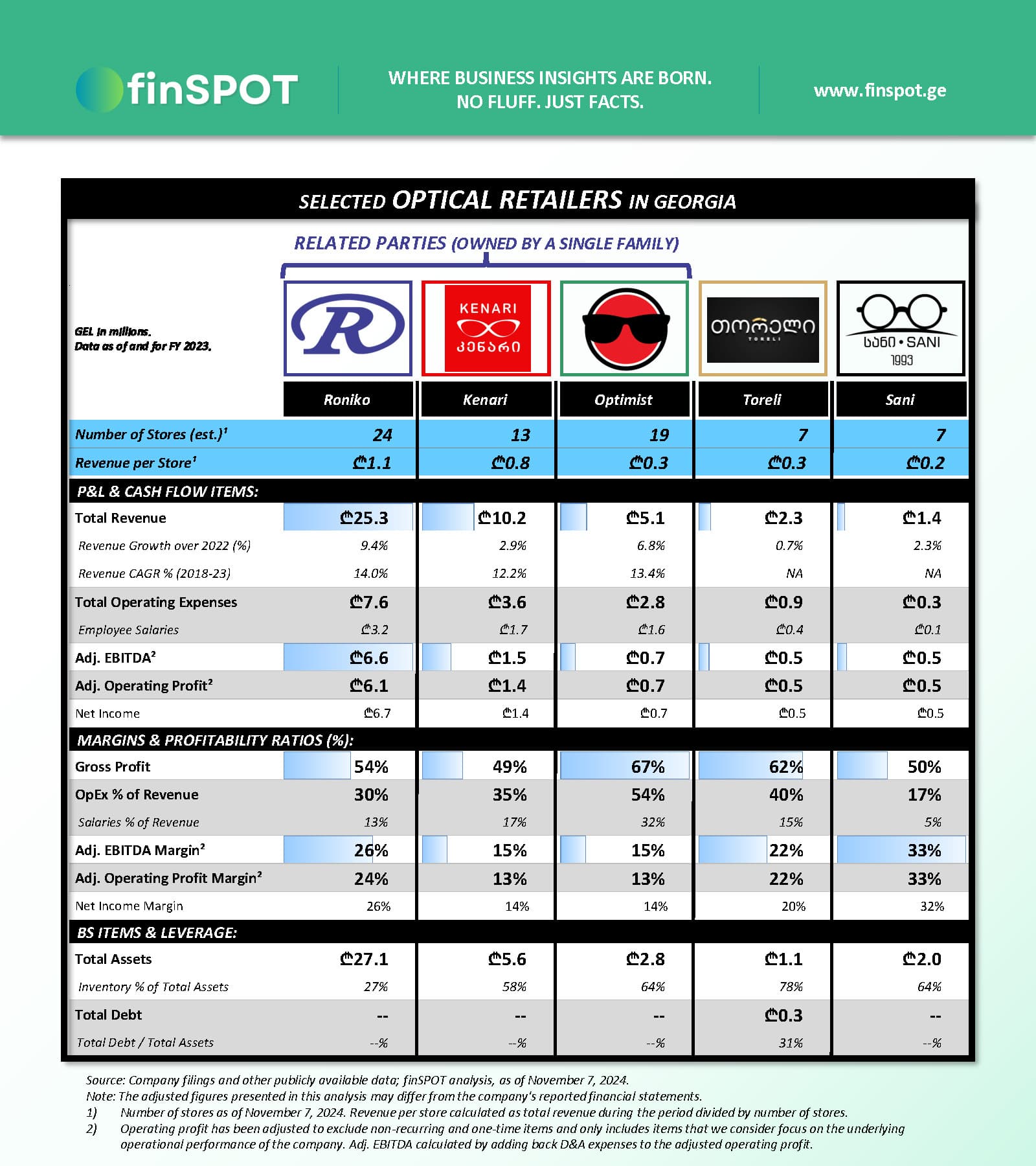
 A look at the optical retail business through the following 5 companies:
 Roniko LLC (Roniko)
 Kenari LLC (Kenari)
 Gemini LLC (Optimist)
 Toreli LLC (Toreli)
 Sani LLC (SANI)
The companies' core business is importing optical products (sunglasses, optical frames, contact/cosmetic lenses and so on) and selling them retail and wholesale.
The undisputed leader of the optical market is Roniko, together with 2 related optical companies – Kenari and Optimist. All three belong to one individual or members of his family.
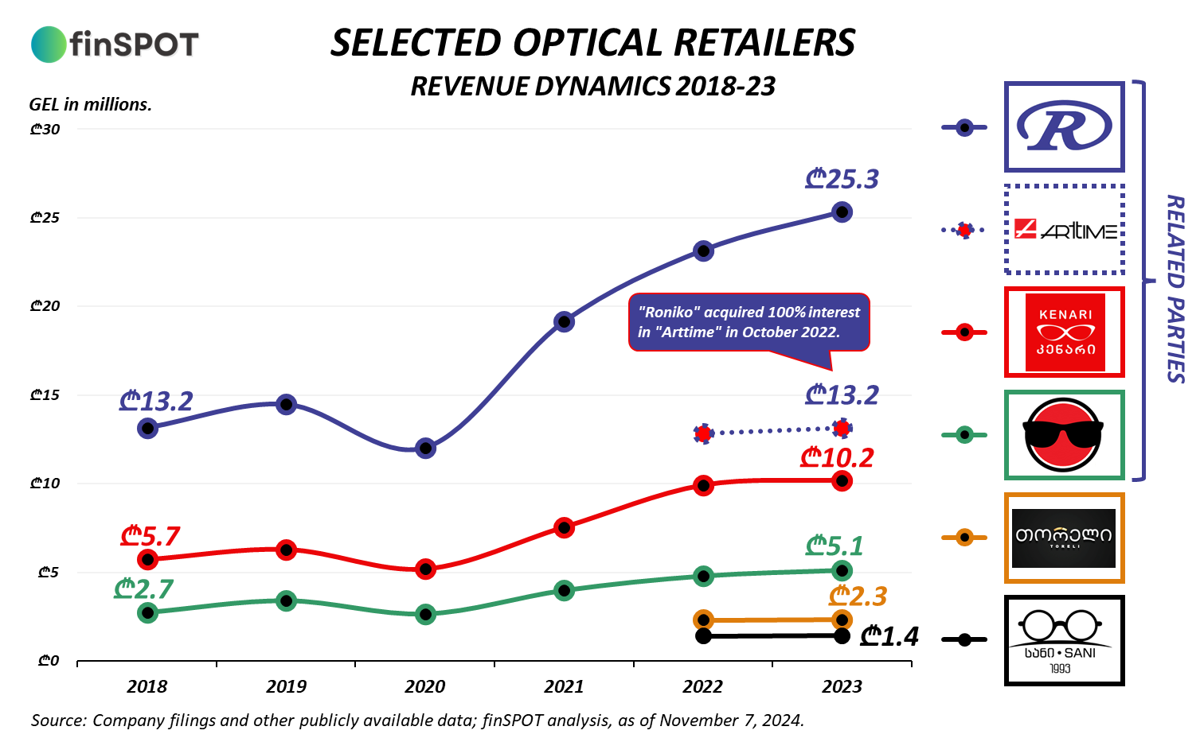
Notably, at the end of 2022 Roniko bought 100% of Arttime, a watch and jewellery retailer, for ₾7.5 million. For some reason Roniko has not yet consolidated Arttime in its statements. The transaction was funded entirely with cash generated by the company, without borrowing.
As a result of this transaction, Roniko, together with its subsidiary and related companies, took the leading position in the optics and accessories market, with combined group revenue of ₾54 million (the sum of all related parties' revenue, before eliminations).
Apart from Roniko and its related companies, the optical market consists of relatively small players. 2 of them are included in the analysis.
Retailers of glasses and optical frames have quite high margins and profitability. The companies' weighted average gross profit margin is 55% and EBITDA margin 22%. Given that most of the companies have no borrowings at all, they have enough free cash flow left to pay dividends.
For the financial analysis, we look at 2023 data.
Roniko is the highest-revenue optical company in Georgia. Its revenue was more than ₾25 million, almost 2 times its 2018 revenue.
Revenue at the two companies related to Roniko, Kenari and Optimist, was ₾10 and ₾5 million respectively. Like Roniko, both almost doubled their revenue in 2018-23.
The other 2 companies have relatively small revenue and slow growth. Toreli's revenue was ₾2.3 million, up just 0.7% on the year. Sani's revenue was ₾1.4 million, annual growth of 2.3%.
Optical retailers' gross profit margins are in the range of 49%-67%.
Most of the companies' operating expenses are salaries and rent. At the three largest optical retailers operating expenses are in the range of 30%-55% of revenue.
With high gross margins and well-managed operating expenses, the companies' profitability is quite high. Operating and EBITDA margins average 21% and 22% respectively.
Most of the companies have no borrowings. The large retailers therefore have enough free cash flow left to pay dividends. Cumulative dividends paid by the companies in 2018-23:
Roniko: ₾7.2 million
Kenari: ₾2.8 million
Optimist: ₾1.4 million
Toreli: ₾84 thousand (paid in 2022-23; information for earlier years is not available)
Sani: ₾161 thousand (paid in 2022-23; information for earlier years is not available)
The chart below shows the companies' revenue in 2018-23. The revenue of Arttime LLC is also included, since 100% of the company belongs to Roniko. The parent has not yet consolidated Arttime in its financial statements, which is why I show it separately.

For Toreli and Sani, financial data before 2022 is not available:
Company ownership:
1️⃣ Roniko
💼 Owner:
- Rolandi Javakhia: 100%

2️⃣ Kenari
💼 Owners:
- Irakli Javakhia: 25%
- Nikolozi Javakhia: 25%
- Mzia Pkhaladze: 8%
- Besik Sulamanidze: 7%
- 7 individuals with 5% stakes: 35%

3️⃣ Optimist
💼 Owner:
- Rolandi Javakhia: 100%

4️⃣ Toreli
💼 Owners:
- Davit Alimbarashvili: 50%
- Ia Shotadze: 50%

5️⃣ SANI
💼 Owner:
- Nikolozi Skhirtladze: 100%